01 — The problem
There is nothing to put in a catalogue
This factory doesn't make a hundred products. It makes a dozen shapes, each of which becomes a product once you attach numbers to it. A straight run is a width, a height, a length, a material and a connection at either end. Change one number and it is a different item at a different price.
Which means the range can't be listed, browsed or added to a basket. So a request arrives as a description in words — usually dozens of lines of it — and someone in the office draws each fitting to be sure of what was meant, works out the metal, prices it and types the quote back. Every request, by hand, before anyone has ordered anything.
02 — What I built
Numbers in, geometry out
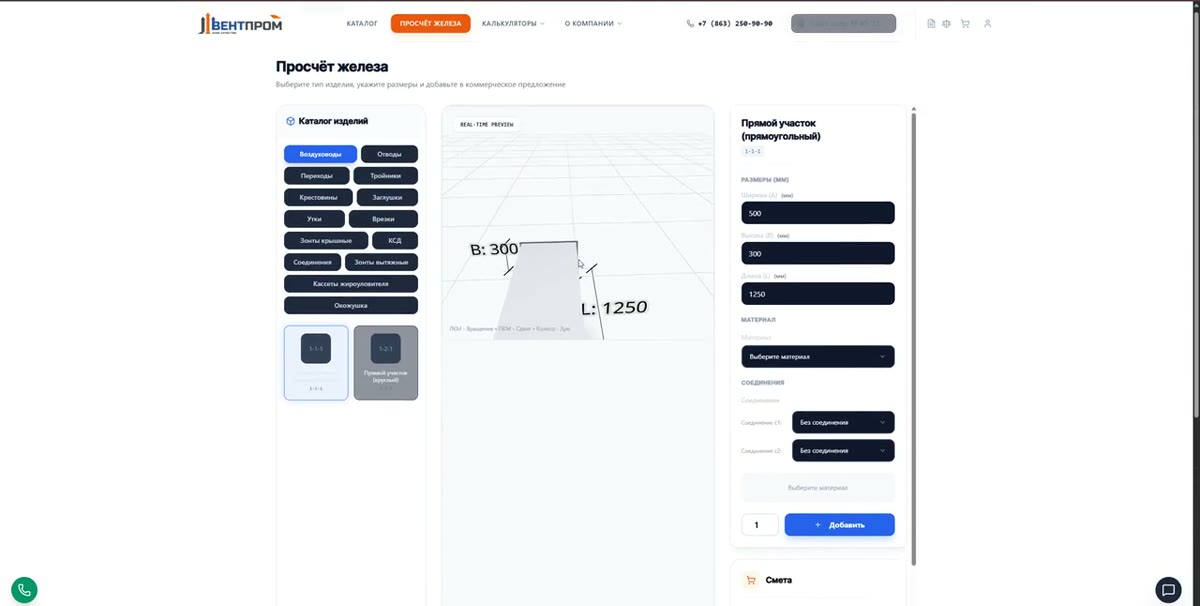
A configurator where the product doesn't exist until you specify it. There is no library of ready models to pick from, because there couldn't be one — the geometry is generated from the parameters as they are entered, and redrawn on every keystroke.
Live — drag it, or type your size
Straight run · rectangular
blank = 2 × (A + B) + 60 mm seam · mass = blank × L × gauge × 7.85 g/cm³
Geometry and mass are computed, not mocked up. The cost line multiplies that mass by a
placeholder €1.80/kg for galvanised sheet — the production tool prices against the
client's own rates, across the whole nomenclature, and adds connections and fittings.
- 01 Pick the shapeA dozen families of fitting, each one a generator rather than a product.
- 02 Type the numbersWidth, height, length, angle, material, connection at each end — the parameters the workshop already thinks in.
- 03 Watch it redrawThe preview rebuilds live and carries its own dimension lines, so the part on screen is visibly the part you meant.
- 04 Take the price with itCosting reads the same parameters as the geometry — the number moves when the dimensions do.
- 05 Build the specificationEach item joins a running spec with its quantity and cost, and the whole list goes to the factory as one document.
- Straight runs
- Bends
- Transitions
- Tees
- Crosses
- Caps
- Offsets
- Saddle taps
- Connections
- Roof cowls
- Extract cowls
- Grease cassettes
- Casings
03 — For the sales desk
The request arrives already specified
The estimating work doesn't disappear — it moves to the moment the buyer is deciding, and to the person who knows what they want. What reaches the office is the result.
04 — Under it
Built with
- Parametric geometry
- Real-time preview
- Dimension lines
- Catalogue-driven costing
- Specification output
The drawing is the easy half. The work is in the rules: every family of fitting is a function — parameters in, geometry and material out — and each one has to agree with how the workshop actually cuts and joins the part. Costing runs off the same parameters as the geometry, so the preview and the price can never end up describing different objects. The specification is generated from those same values — dimensions, material, connections, quantity — in the form the factory already works from, which is what makes it a quoting tool rather than a drawing toy.
Next case
Standes — 3D shelving configurator
The customer lays out their own room in 3D, walks the finished layout in AR at full size, and sends the factory a plan instead of an email thread.